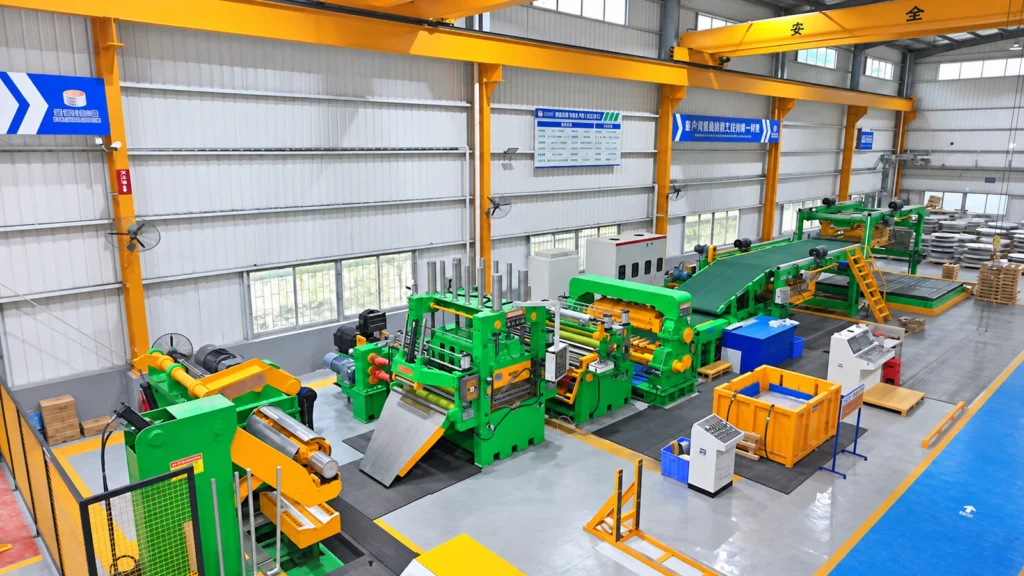
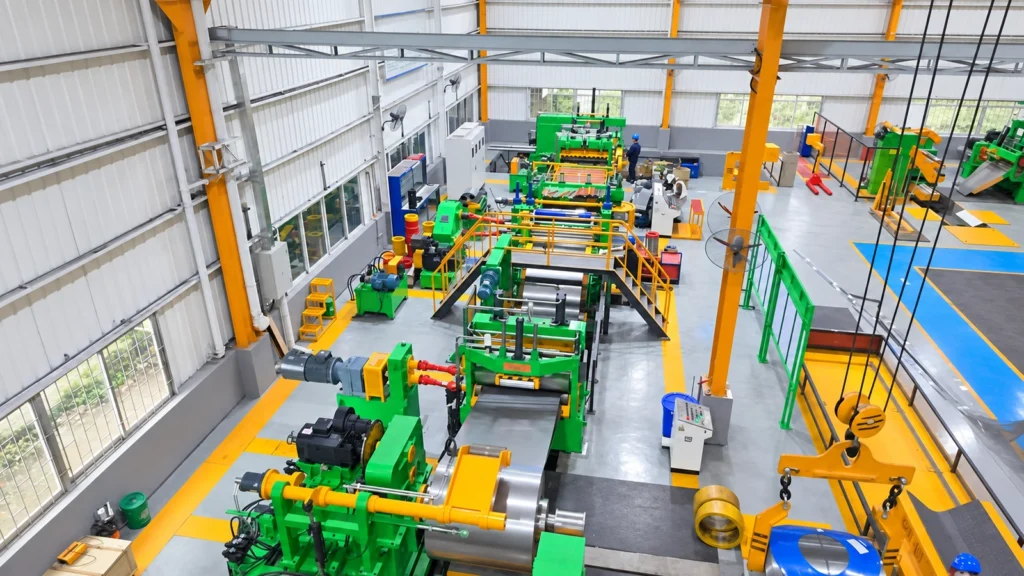
When a coil processor faces a flatness complaint, the words straightener and leveler are sometimes used as if they mean the same thing. In a purchase decision, that shortcut can create a costly mismatch. The right choice affects how reliably a line feeds downstream equipment, how well processed strip performs in later operations, and how much avoidable rework or sorting a service center must manage.
Both machines use controlled bending through rolls. Their intended process role, however, can be different. A buyer should begin with the material condition and the required output—not with a familiar machine name. This practical guide explains the distinction, the questions that matter during specification, and how the choice fits into a complete coil-processing line.
The names overlap, but the process problem comes first
Machine terminology is not perfectly standardized across the industry. One supplier may use straightener for a compact corrective section; another may describe a larger configuration as a straightening or leveling unit. That is why a name alone is not a technical specification.
The useful starting point is to identify the defect or process risk. Is the incoming coil carrying longitudinal coil set? Is the strip drifting, showing crossbow, or behaving inconsistently when it reaches a shear, press, weld station, or recoiler? Does the processor need visibly flatter sheets for stacking, fabrication, or a sensitive downstream operation? Edge wave, center buckle, local damage, residual stress, surface condition, and material variability may each point to a different level of process control.
No roll-based correction section should be expected to solve every incoming condition. The material grade, thickness range, strip width, yield behavior, coil weight, surface sensitivity, and target flatness must be reviewed together. For demanding applications, the final solution should always be confirmed through project-specific engineering.
What a straightener is normally selected to do
A straightener is commonly selected when the primary requirement is to reduce coil set or improve strip presentation as material enters the next stage of a line. By repeatedly bending the strip in alternating directions, it can help make the material more stable for feeding, guiding, shearing, or recoiling. The objective is often a dependable strip path rather than the tightest possible sheet-flatness result.
Where a straightener can make economic sense
A straightening section may be a sensible choice when incoming material is relatively consistent and the downstream process mainly needs stable feeding. Examples can include an entry section ahead of another process, a line where the product remains in strip form, or an application where the customer’s usable-flatness requirement is moderate. It can also be a practical part of a wider coil-feeding arrangement when the process team has clearly defined the acceptable residual shape.
That does not mean a straightener is a “basic” answer for every coil. High-strength grades, wide strip, demanding surface requirements, and variable incoming coil condition can change the calculation. A buyer should ask what defect the equipment is expected to correct and how the result will be measured after the next operation—not simply whether the machine is described as a straightener.
What a leveler is selected to control
A leveler is generally chosen when the line requires more deliberate control of strip shape and flatness. Its roll arrangement, support strategy, adjustment range, and control approach are designed around applying controlled deformation across the strip. The aim is to manage residual stresses more effectively so the processed material behaves more consistently in downstream work.

The 4HI leveler shown above is one example of a roll-based leveling section. The exact roll arrangement, support design, applicable material range, and final flatness expectation must be confirmed for each project.
Flatness is not the same as looking straight
A strip can appear straight along its length while still having shape issues that become visible after cutting, stacking, blanking, forming, or welding. A sheet may also lie reasonably flat in one location but react differently after the next process releases residual stresses. For that reason, a buyer who needs reliable flatness should define the final part or sheet condition, not just the appearance at the exit of the machine.
Leveling requirements become especially important when material will be cut into sheets, supplied to fabrication operations, or processed through equipment that needs a stable and repeatable input. In a cut-to-length line, the leveling section must be considered together with entry control, shearing method, discharge, and stacking. The appropriate configuration depends on the complete process route, not one isolated machine.

Compare the downstream route, not only the roll section
For a coil processor, the choice between a leveler and a straightener should connect directly to the value created after the correction section. A line producing slit strip for recoiling has different priorities from a line producing sheets for controlled stacking. A customer feeding a press, laser system, or fabrication operation may have a different tolerance for residual shape than a customer making general stock sheets.
For example, an integrated 1850mm Cut to Length Line for Automotive & Galvanized Steel should be evaluated as a system: incoming coil condition, leveling requirement, cut quality, finished-sheet handling, and the customer’s downstream use should be discussed together. Likewise, a High Speed 1650 Type Flying Shear Line requires the correction and feeding sections to be matched to the selected production method, rather than treating the shear as an independent purchase.
This system view also prevents a common quotation problem: specifying a machine from a nominal thickness range alone. Thickness is important, but it does not describe strength, width, surface condition, coil geometry, or the final quality expectation. Two coils with the same nominal thickness can demand very different processing approaches.
Six buyer questions that improve equipment selection
- What material will be processed? Identify grade family, condition, approximate strength behavior, thickness range, width range, and surface sensitivity.
- What is the incoming coil condition? Describe coil set, crossbow, edge wave, center buckle, local damage, and how consistently those conditions occur.
- What is the required final result? Define whether the goal is stable feeding, reduced coil set, improved sheet flatness, controlled stacking, or a downstream fabrication requirement.
- What happens after correction? State whether the strip will be slit, recoiled, cut to length, welded, blanked, formed, or supplied as sheet.
- How will quality be checked? Agree on a practical acceptance method. A visual check, a flatness criterion, and downstream performance are not always equivalent.
- How variable is production? A line that changes among material types, widths, and jobs benefits from clear setup discipline and repeatable recipes.
These questions give an equipment manufacturer the information needed to propose an appropriate line concept. They also help the buyer compare quotations on process scope instead of comparing only headline machine names.
Line design and controls influence the result
A leveler or straightener does not operate in isolation. Decoiler behavior, entry guiding, strip tension, pinch rolls, loop control, lubrication or surface protection, shear timing, and exit handling can all influence how material travels and how the final product looks. Poor alignment or unstable tension can undermine a well-selected correction section. Conversely, a balanced line can make setup more repeatable and simplify operator decisions.

Controls matter because production is rarely one fixed coil run. For recurring material families, recipe-based setup and clear feedback can help operators return to known settings more consistently. This is one reason that coil-processing automation beyond line speed deserves attention: useful automation supports setup discipline, process visibility, and quality traceability as well as output rate.
Automation should not be treated as a substitute for a sound mechanical process design. The first step remains a clear definition of material, quality target, and downstream route. Once those are known, the control concept can be specified to make the chosen process easier to repeat.
A practical approach for XIONGJIN MACHINERY buyers
When discussing a new line with XIONGJIN MACHINERY, buyers can accelerate engineering review by providing a representative material list, sample shape concerns, intended downstream processes, and a realistic definition of finished-product quality. This makes it easier to decide whether the application calls for a compact straightening function, a more comprehensive leveling section, or a different line arrangement altogether.
The key is not to assume that every coil or every final use needs the same equipment. A technically sound selection balances material behavior, product requirements, productivity, maintenance access, and the commercial value of better output. Exact configuration, applicable thickness range, and performance expectations require confirmation against the customer’s actual material and process conditions.
Conclusion
The leveler-versus-straightener decision is ultimately a process decision. A straightener can be an efficient answer when the goal is stable feeding and coil-set reduction. A leveler is often the more appropriate choice when strip shape and sheet flatness are central to downstream value. By defining the incoming coil condition, final quality target, and full line route before requesting a quotation, a processor gives the equipment supplier the best basis for an effective and commercially sensible solution.