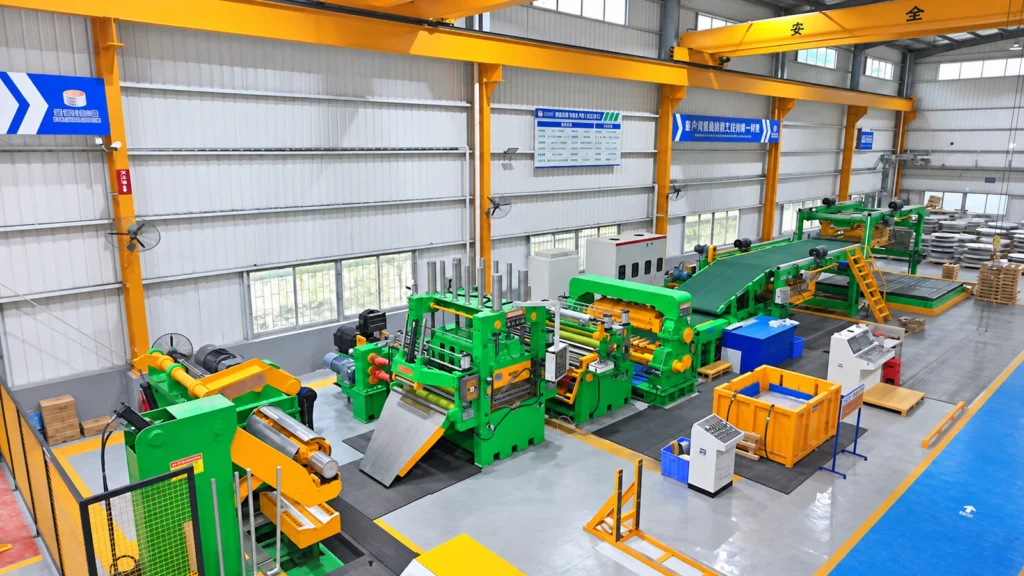
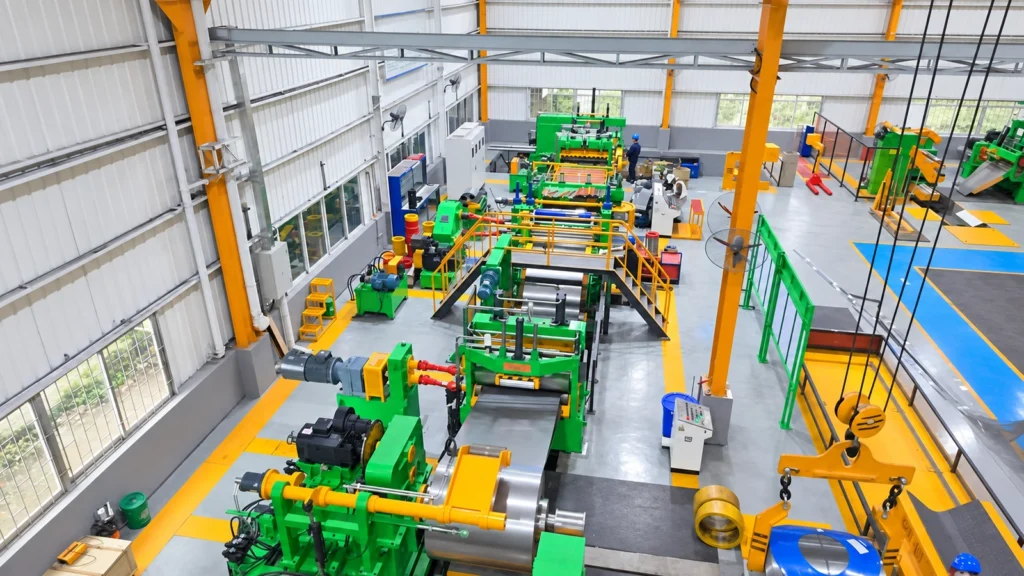
For a modern steel service center, automation is no longer just a way to run a coil-processing line faster. The more important question is whether the line can repeat a verified setup, protect strip quality, guide operators through changeovers, and preserve the processing information that customers increasingly expect. A fast line with inconsistent setup discipline can create more scrap, rework, and risk than value.
From a coil-processing equipment manufacturer’s perspective, the best automation strategy connects mechanical design, drive control, sensors, operator guidance, and production records. The exact functions depend on the material, width, thickness, coil weight, slit pattern, and downstream requirement. Those application limits must be confirmed during engineering; they should never be assumed from a generic automation package.
Why automation is now a process-control decision
Service centers and contract processors often handle many grades, widths, and order sizes in the same week. A slitting line may move from a wide hot-rolled coil to a narrower stainless or non-ferrous job. A cut-to-length line may change from a standard production order to a short batch with tighter flatness or length requirements. Each change creates opportunities for incorrect settings, unnecessary walking, unsafe adjustments, and inconsistent first-off pieces.
Automation adds value when it controls variation at these decision points. It should help the operator load the correct job, confirm the material identity, set the line safely, and recognize when the process is moving outside its expected window. In other words, automation should make the right process easier to repeat.
1. Recipe-driven setup should reduce variation
A useful recipe is more than a stored speed value. Depending on the line, it can include the material grade, nominal thickness and width, target slit pattern, knife arrangement, spacer information, entry-guide position, pass-line settings, tension references, recoiler parameters, leveler settings, and shear timing. The recipe should provide a controlled starting point while still allowing authorized engineering adjustments for actual material behavior.

For slitting, recipe discipline can reduce errors during knife and spacer preparation. For leveling and cut-to-length, it can help coordinate roll-gap references, feed calibration, loop control, and cutting sequence. A recipe should also show its revision history and identify which settings require confirmation before the line starts. This is especially important when a buyer processes materials that behave differently even when their nominal thickness is similar.
2. Sensors should protect the process, not merely collect data
Automation becomes useful when sensor inputs lead to decisions. Coil diameter, strip position, line speed, drive load, loop height, tension response, and tail behavior can all help the control system detect abnormal conditions. Edge-guiding feedback can help maintain strip alignment. Load and position feedback can support safer movement of coil cars, pinch rolls, guides, and other handling equipment.
The practical question is not how many sensors a line contains. It is whether the system uses them to create clear alarms, interlocks, controlled stops, and diagnostic information. An operator should be able to understand what happened and what must be checked next. A well-designed interface separates a material problem from a setup problem, a mechanical problem, and a safety-related stop.
3. Quality control must include strip behavior
Line speed is only one part of productivity. A coil-processing line must also deliver usable output. Depending on the application, the quality window may include slitting burr, edge condition, camber, telescoping, recoiling tightness, surface protection, flatness, cut length, and stack or bundle consistency.
Automation should therefore coordinate speed, tension, guiding, acceleration, deceleration, and stopping rather than optimize one value in isolation. Thin strip can be sensitive to tension stability and edge guidance. Heavier or higher-strength material can place greater demands on drive torque, machine stiffness, braking, and material support. A leveler may need a different approach from a straightener when the problem involves crossbow, edge wave, or center buckle. Exact thickness, grade, speed, and accuracy capabilities remain line-design questions requiring confirmation.

For this reason, a buyer should ask how the control system links process settings to measurable quality checks. Even when inspection remains partly manual, the production record should make it easier to connect a defect to a material lot, recipe version, setup change, or operator decision.
4. Safer changeovers are a productivity gain
Changeover automation should reduce exposure to avoidable handling tasks. Useful functions may include guided coil loading, automatic centering, controlled threading, powered guide adjustment, recipe-based pass-line positioning, and clear safe-state logic. These functions do not remove the need for trained operators. They help operators perform the same sequence consistently and keep people away from unnecessary pinch points or moving equipment.
Safety and productivity should be designed together. A control system that forces operators to bypass alarms or repeat manual positioning steps will eventually lose both benefits. The better approach combines guarded zones, visible status information, permissive logic, manual jog controls where appropriate, and a recovery procedure that explains how to resume after a stop.
5. Traceability turns processing data into customer value
For many service centers, the useful output is not only the slit coil or cut blank. It is also the confidence that the material was processed according to the correct order and can be identified later. A practical traceability record can connect the incoming coil ID, grade or heat information, order number, recipe revision, operator, key settings, inspection results, and outgoing coil or bundle IDs.
This information supports repeat orders and root-cause analysis. If a customer reports a flatness issue or a recoiling problem, the processor can review the actual job history instead of relying on memory. If the same material is processed again, the previous recipe can become a reference rather than an unverified shortcut. Integration with ERP or production-management systems may be appropriate, but the scope should match the processor’s actual workflow and data-retention needs.
Questions buyers should ask before specifying automation
Buyers should ask whether the proposed system can store job recipes, manage revision permissions, support manual engineering adjustments, explain alarms, record quality checks, and export production data. They should also ask how the system behaves when material conditions differ from the nominal recipe, how operators recover from a stop, and which functions are standard, optional, or subject to application confirmation.
It is also useful to review the complete line rather than the control cabinet alone. XIONGJIN project references for a belt-tensioner double-slitter line, an 1650 flying-shear line, and an 1850 mm cut-to-length line illustrate why automation discussions should be tied to the actual process layout and product mix.
Conclusion
The strongest coil-processing automation projects do not begin with a promise of maximum speed. They begin with a clear definition of repeatability, safety, quality, and information flow. Recipe-driven setup, useful sensors, stable tension and guidance, safer changeovers, and traceable production records can make a line easier to operate and easier to improve.
For any new or upgraded slitting, leveling, or cut-to-length line, the right automation package depends on the material range and the customer’s process objectives. A detailed engineering review should confirm the applicable capabilities before equipment selection and before performance expectations are set.